173: Joaquín Ambía

This video podcast episode features an in-depth conversation with a researcher deeply involved in the University of Texas at Austin’s Formation Evaluation Consortium (FEC) and in developing the UTAPWeLLS software. The discussion begins with a personal background, tracing the guest’s academic path from Mexico City and Monterrey to the University of Houston and beyond, highlighting a strong foundation in physics and computational biophysics. The guest shares insights into the practical application of Monte Carlo simulations in DNA structural analysis and the transition into energy-sector software.

The episode focuses on the story and evolution of UTAPWeLLS, a comprehensive suite of physics-based simulators designed to replicate well-logging measurements and invert data to characterize subsurface formations. Developed since the late 1990s under the leadership of Carlos Verdín, this open, collaborative, consortium-based software integrates multiple industry tools, giving participants a unique platform to test hypotheses with minimal liability. The discussion explores the software's scientific rigor—grounded in Maxwell's equations and incorporating complex physics such as resistivity, gamma ray, nuclear, and sonic measurements—to accurately simulate tool responses through layered earth models. The software’s capacity to unify disparate simulators into an accessible, user-friendly platform has made it invaluable to the petroleum engineering and petrophysics community.

Looking ahead, the guest highlights the transformative impact of artificial intelligence (AI) on coding, simulation speed, and user accessibility. The team is actively migrating the software from MATLAB to Python to improve integration with commercial platforms and support scripting and natural language interfaces to meet evolving industry needs. The consortium’s unique "safe space" enables collaborative problem-solving between operators and service companies without commercial constraints or liability. Carlos Verdín's strong leadership is highlighted as a critical factor in sustaining the consortium for over 26 years. His ability to unite major industry players and foster an environment of transparent scientific dialogue is central to UTAPWeLLS’ enduring success.

The guest concludes with reflections on career trajectory, the future potential of automated software maintenance, and the evolving landscape of energy sector problem-solving driven by AI and computation.

Highlights

🔬 Deep physics foundation drives UTAPWeLLS’ accurate well logging simulations.

🌍 UTAPWeLLS functions as an industry consortium software hub for formation evaluation.

🎯 Key focus: matching synthetic earth models to real data via inversion techniques.

💡 Leadership and collaboration by Carlos Verdín fuel 26+ years of consortium success.

🤖 AI is revolutionizing coding speed and usability, prompting a Python migration.

🛠️ Software integrates multiple simulators, enabling experimental and off-the-shelf testing.

🔐 Consortium provides a low-liability environment for open R&D among operators and service companies.

Read More
172: Domenico Crisafulli

This episode of the PBE Podcast features Domenico Crisafulli, a recent PhD graduate from UT Austin’s Formation Evaluation Program, who shared his academic journey, research innovations, and views on emerging technologies like AI in the energy sector. Domenico’s PhD research focused on leveraging modern physics and technology, particularly acoustic and electromagnetic measurements using drones, to enhance the accuracy and efficiency of petrophysical data acquisition and interpretation. His work bridged laboratory experiments, numerical modeling, and practical field applications, resulting in novel methods to analyze rock properties through non-traditional means.

He emphasized the importance of collaboration, persistence, and adaptability during his doctoral studies, noting that working with colleagues accelerated breakthroughs and sharpened his research. After completing his PhD, Domenico transitioned into an industry role at BP as a petrophysicist, practicing conventional log analysis while applying the disciplines and teamwork mindsets cultivated during his academic tenure. The conversation also explored the transformative influence of AI and machine learning in geoscience and engineering workflows. Domenico sees AI not as a replacement but as a powerful tool that, when combined with human expertise, can significantly accelerate data analysis, improve decision-making, and refine scientific outputs. He stressed adopting AI responsibly and avoiding over-reliance, reflecting a broader generational perspective.

Finally, Domenico underscored the enduring value of the consortium led by Dr. Carlos Verdeen at UT Austin. With over 26 years of industry-academic collaboration, this consortium continues to evolve to meet industry demands, foster innovation, and support talent development—ensuring its legacy and impact on future energy leaders.

Highlights

🚀 Domenico developed advanced drone-based acoustic and electromagnetic measurement systems for core sample analysis.

🎓 His PhD combined lab measurements, numerical modeling, and field data to better characterize rock properties.

🤝 Collaboration and persistence were key themes in overcoming PhD challenges and advancing research.

🤖 Domenico views AI as a complement to human skills, enhancing geoscience workflows when used wisely.

🏢 After graduation, Domenico joined BP as a petrophysicist, applying both traditional and innovative approaches.

🔄 The UT Austin consortium adapts dynamically to industry needs, linking academia and energy companies effectively.

📈 The consortium’s support network fosters career growth, with alumni now industry leaders sustaining its legacy.

Read More
171: Alejandro D. Lopez Rojas and Julio C. Villarroel

This episode features an insightful conversation from UT Austin’s Formation Evaluation program with two PhD students, Alejandro and Julio, guided by Professor Carlos Torres-Verdin. The dialogue explores cutting-edge research in petrophysics, focusing on energy challenges such as identifying lithium resources, hydrogen storage, geothermal energy, and carbon capture. By applying modern physics, especially nuclear physics and formation evaluation tools like pulsed neutron methods, the researchers aim to revolutionize how energy resources are detected, quantified, and optimized. Alejandro’s research focuses on detecting and quantifying lithium brines within subsurface formations using petrophysical techniques combined with nuclear physics and isotope geology. Given lithium's critical role in batteries and clean energy, their work explores the complex geology of lithium-rich “salars” in South America and how integrating physics measurements can improve resource estimates. Julio’s work centers on using pulsed neutron tools to evaluate hydrogen storage capacity in depleted reservoirs or aquifers, essential for optimizing emerging hydrogen energy solutions. The podcast also highlights the importance of communication skills alongside technical expertise for scientists aiming to lead the evolving energy sector. Overall, the conversation emphasizes collaboration, curiosity, and the evolution of energy research, showcasing how young scholars leverage interdisciplinary methods to address global energy and environmental challenges.

Highlights

🧪 Alejandro’s PhD research pioneers the use of nuclear physics to detect lithium concentrations in subsurface brines.

💧 Julio’s work applies pulsed neutron techniques to monitor hydrogen storage, key for future clean energy systems.

🌍 Lithium resources in the Andes region, particularly in Bolivia’s salars, are complex and critical for global energy demands.

🎓 UT Austin’s Formation Evaluation program integrates advanced petrophysics and formation evaluation in energy research.

🗣 Strong communication skills are vital for technical experts aspiring to managerial roles in the energy industry.

🤝 Collaboration among multidisciplinary scientists accelerates innovation and problem-solving in geoscience and engineering. 🎙 The SPWLA student chapter at UT Austin fosters leadership and outreach, with plans for digital media engagement.

Read More
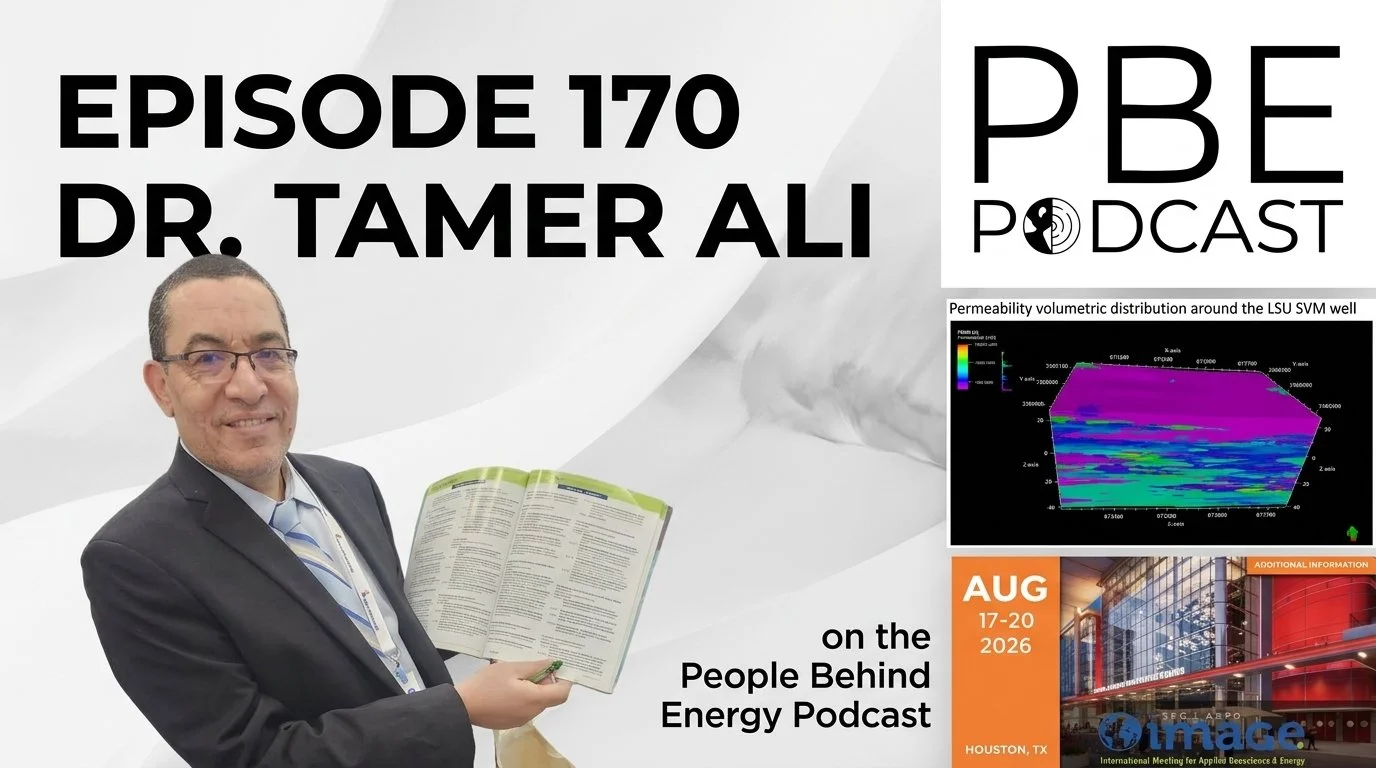
170: Dr. Tamer Ali

In this episode of the PBE podcast, host Troy Tittlemier sits down with Tamer Ali at IMAGE 2026 to explore the cutting edge of geology, geophysics, and AI integration. Tamer shares his incredible journey from growing up on a farm in the Nile Delta to processing seismic data across six countries, and eventually earning degrees from the Colorado School of Mines and LSU. The conversation dives into Tamer's groundbreaking PhD dissertation, which uses a novel AI hybrid model—combining generalized additive models (GAM) and k-means clustering—to quantitatively integrate geophysical and geological data. By predicting grain size and permeability in shallow, unconsolidated sediments, Tamer's work precisely locates dangerous water seepage beneath structures like the LSU Veterinary School of Medicine. This localized, quantitative approach could save tens of millions of dollars annually in levee restoration and prevent catastrophic infrastructure failures across the Lower Mississippi Valley.

Episode Highlights:

  • The Elevator Pitch: An introduction to Tamer's extensive academic background and his focus on quantitative data integration using AI.

  • Roots in the Nile Delta: Tamer discusses his Egyptian heritage, farming background, and how a geologist uncle sparked his early love for earth sciences.

  • The Industry Grind: Balancing a full-time 3D seismic processing career at WesternGeco with a grueling daily commute to earn a master's degree at Colorado School of Mines.

  • Quantitative vs. Qualitative: The shift from subjective visual inspections to writing robust Python and R code to build a new hybrid AI model.

  • The LSU Vet School Project: Securing an AAPG grant and Army Corps permits to investigate uneven stress and water seepage beneath the university building.

  • K-Means Clustering for Civil Engineering: Applying five distinct data properties to accurately classify subsurface facies from zero to 90 feet.

  • Saving Millions & Preventing Disasters: How Tamer's precise seepage detection can prevent future tragedies like Hurricane Katrina and save an estimated $50 million a year.

  • The Future of Petrophysics: Tamer's next chapter pursuing the only specialized petrophysics master's degree in the United States at Texas A&M-Kingsville.

Read More
169: Dalma Cerro Arrieta

In this episode, we sit down with Dalma Cerro Arrieta, a petroleum engineer and PhD candidate at UT Austin, to discuss her journey through the geosciences. Dalma shares her path from studying at a public school in northern Colombia to learning Portuguese in three months for a Master's degree in Brazil, and eventually transitioning to a PhD program in Texas. The conversation dives into the technical details of geomechanics, her time working for Petrobras in the Brazilian pre-salt layers, and her current research using NMR and resistivity logs to estimate permeability in complex carbonates.

Episode Highlights:

  • 00:00:00 - Origins & Education: Dalma discusses growing up in Colombia and her early interest in organic chemistry before shifting her focus to petroleum engineering at the National University in Medellín.

  • 00:04:17 - A Life-Changing Encounter: Dalma explains how volunteering at a university geomechanics conference led to a meeting with a Brazilian professor, resulting in a master's degree offer in Brazil.

  • 00:05:51 - Geomechanics Simplified: A breakdown of earth mechanics, wellbore stability, and how mud weight is used to prevent well fractures and keep fluids inside the rocks.

  • 00:09:35 - Rock Frackability: An exploration of the rock properties used in frack modeling, including Poisson's ratio and Young's modulus.

  • 00:11:17 - Innovative Fracking Concepts: A discussion on a patented, non-traditional "kinetic frac" method that utilizes expanding CO2 bubbles to shatter rock.

  • 00:16:48 - Industry Experience at Petrobras: Dalma shares her experience working on wellbore stability in Brazil, specifically focusing on the challenges of drilling through salt seals to reach presalt carbonate reservoirs.

  • 00:18:28 - The Journey to UT Austin: The story of how Dalma relocated to Austin to learn English, eventually passing her GRE and TOEFL exams to begin her PhD in formation evaluation.

  • 00:21:15 - Permeability in Complex Carbonates: Insights into Dalma's current research on combining Nuclear Magnetic Resonance (NMR) and electrical resistivity logs to navigate the challenges of micropores and heterogeneous rock.

  • 00:22:22 - Protecting NMR Data: Practical advice on using ditch magnets in mud tank possum bellies to clear out iron and prevent electrical field disturbances during NMR logging.

  • 00:24:26 - Leadership in SPWLA: Dalma highlights the importance of the UT Austin SPWLA student chapter for building networking skills, forcing student engagement, and connecting academia with industry professionals.

  • 00:31:21 - Demystifying Wettability: A concise explanation of wettability and how rock mineralogy determines its affinity for holding oil versus water.

Read More
168: Axel Jeconiah and Christian Dominguez

In this episode of the People Behind Energy (PBE) podcast, host Troy Tittlemier travels to UT Austin to sit down with PhD students Axel Jeconiah and Christian Dominguez from Dr. Carlos Verdin's formation evaluation program. The conversation dives deep into the future of the energy industry, focusing heavily on new-generation geothermal technologies, the integration of machine learning, and advanced fracture detection methods. Axel and Christian share their unique journeys into the energy sector—from growing up in Qatar and Houston to pursuing cutting-edge DOE-funded research. The episode explores how modern physics and engineering are being applied to create more efficient and sustainable energy solutions, including the economic challenges of mapping geothermal fractures and the vision for distributed geothermal micro-wells.

Episode Highlights

  • 00:00:00 - Introduction at UT Austin and meeting the PhD students in the formation evaluation program.

  • 00:01:46 - Axel and Christian share their backgrounds, from Houston and Qatar, and what inspired them to pursue petroleum engineering.

  • 00:04:33 - Breaking down the basics of geothermal energy and how water heat is converted to turbine power.

  • 00:06:11 - Exploring "new generation" geothermal technology and the process of hydraulically fracturing hot dry rock.

  • 00:09:41 - The experimental research surrounding the extraction of lithium from underground geothermal brines.

  • 00:11:03 - Discussing Texas geothermal anomalies and the impact of tight gas on thermal conductivity in the McAllen area.

  • 00:13:17 - Defining the difference between Machine Learning and AI, and their growing necessity in the energy sector.

  • 00:15:41 - Axel details his DOE-funded PhD research on using electromagnetics and conductive proppant to map fractures through casing.

  • 00:23:48 - Vision for the future: Why distributed networks of 20-megawatt micro-wells are more effective than giant, single-source geothermal wells.

Episode Sponsors

  • Mandrill Energy Solutions: Providing tailored staffing, solids control solutions, and equipment solutions to keep energy operations running safely and efficiently.

  • Resonate H2O: A premium hydration mix featuring electrolytes and essential amino acids to support everyday focus and performance.

Read More
167: Dave Kennedy, Evolution of UTAPWeLS & Well-Log Modeling

The Evolution of UTAPWeLS & Well-Log Modeling

In this episode of the PBE Podcast, host Troy Tittlemier sits down with Dave Kennedy to explore the history of the UT Austin Formation Evaluation research consortium and the development of the UTAPWeLS software. Dave shares his expansive career journey, spanning from his early days at Georgia Tech and military service during the Vietnam War, to his extensive work with industry giants like Schlumberger, Mobil, ExxonMobil, and Baker Hughes. The discussion dives deep into the evolution of well-log modeling, detailing the industry's shift from the standard 30-year use of the 6FF40 induction instrument to proprietary array induction tools. Dave also highlights how consortium leader Carlos successfully united competing service companies to build a comprehensive petrophysical simulator that continues to push the technological envelope today.

Episode Highlights

  • Introduction to Dave Kennedy, his long-standing association with Carlos since 1986 at Berkeley, and the start of the UT Austin consortium in 2000.

  • Dave’s early life: Attending Georgia Tech, his family's military background, and his decision to join the army as airborne infantry during the Vietnam War.

  • Entering the oil patch: Landing a job at Schlumberger in 1972 after sending out a hundred letters through a vendor catalog.

  • Transitioning to research: Moving to Mobil in 1988, solving Maxwell's equations to understand the 6FF40 induction tool's response function, and adding 100 million barrels to the Statfjord field reserves using forward modeling.

  • The industry shift to array induction tools and the service companies' initial reluctance to share their proprietary hardware specifications and modeling data.

  • The birth of UTAPWeLS (University of Texas at Austin Petrophysical and Well-Log Simulator): How Carlos successfully negotiated with competing service companies to incorporate their models into a unified simulator for the industry.

  • Forward modeling vs. inversion: A breakdown of how UTAPWeLS helps determine hydrocarbon saturation by overlaying guessed formation layer conductivities onto observed tool responses.

  • Dispelling the myth of a "mature industry": How technological advancements like fiber optics, miniaturization, and rare earth magnets for nuclear magnetic resonance keep the oil and gas sector on the cutting edge.

  • Concluding thoughts on the 26-year-old consortium's ongoing evolution, Carlos's leadership, and the modern integration of AI into their research.

Read More
166: Mark Kittridge and Carlos Torres-Verdin

In this episode of the People Behind Energy podcast, Dr. Carlos Torres-Verdín (Professor at the University of Texas at Austin) and Mark Kittridge (Principal and Manager of the Quantitative Interpretation Team at Occidental Petroleum) explore the 26-year history and future of the UT Austin Formation Evaluation Consortium. The conversation details Dr. Torres-Verdín’s journey in establishing an independent academic program for formation evaluation, Mark Kittridge’s perspectives as a long-time industry sponsor, and the core physics behind subsurface reservoir measurements. They also examine how multiphysics modeling, novel sensors, and artificial intelligence are advancing petrophysics, driving reservoir recovery factors, and enabling energy transition applications such as CO2 sequestration.

Key Highlights & Timestamps

  • - Celebrating 26 Years of Innovation: The conversation opens with reflections on the 26-year uninterrupted legacy of the UT Austin Formation Evaluation Consortium and its pivotal role in advancing petrophysics.

  • - Mark Kittridge’s Longhorn Legacy: Mark shares his journey coming to UT Austin in August 1986 for his Master's in Petroleum Engineering under Dr. Larry Lake, discussing how his graduate work laid the foundation for his industry career.

  • - Dr. Carlos Torres-Verdín’s Career Path: Carlos outlines his academic and industry path, from earning his PhD at UC Berkeley to conducting research at Schlumberger (SLB) and working in operations at YPF in Argentina before joining UT Austin in July 1999.

  • - Pitching the Consortium Vision in 2000: Carlos recalls pitching his vision for an academic unit dedicated to formation evaluation, pushing back against the perception that petrophysical technology had reached its limit.

  • - Early Consortium Impact: Mark discusses the immediate value the consortium brought to operators by tying tool physics directly to multiphysics, multiscale data, quantitative interpretation, and downhole formation testing.

  • - The Power of Academic Neutrality: The guests discuss how UT Austin provided a neutral, independent research environment to maximize measurement value without commercial tool bias.

  • - The Future of Subsurface Physics: Carlos highlights future research frontiers, focusing on complex heterogeneous rocks, new in situ sensors, fast computing, and combining physical laws with artificial intelligence to boost reservoir recovery factors.

  • - Demystifying Formation Evaluation: Mark and Carlos break down how petrophysicists translate indirect wellbore measurements (density, acoustic, electromagnetic) into key reservoir properties like porosity, fluid saturation, and permeability.

  • - Evolution of the University JIP Model: The group analyzes how university-led Joint Industry Projects (JIPs) must evolve amid changing academic landscapes and shifting industry funding priorities.

  • - Subsurface Engineering in the Energy Transition: Mark details his work in CO2 sequestration, explaining how traditional petroleum engineering methodologies are being repurposed for carbon capture, groundwater management, and global energy solutions.

Read More
165: Upstream+ with Founder Austin Williams

In this episode of the People Behind Energy (PBE) Podcast, host Troy Tittlemier sits down with Austin Williams, Founder of Upstream+, to unpack the hidden complexities of oil and gas accounting. Austin shares his unique journey from studying organic chemistry to building a revolutionary platform that bridges raw field data and actionable financial insights.

They discuss the industry's struggle with fragmented reporting, why traditional accounting processes are too slow for modern operators, and how Upstream+ serves as an "economic decisions intelligence layer" to stop profit leaks in real time. Austin also shares his compelling perspective on the right—and wrong—ways to leverage AI as a thought partner in highly technical industries.

Read More
164: Petrophysicist Derek Buster

In this episode of the People Behind Energy podcast, host Troy Tittlemier sits down with Derek Buster, a seasoned petrophysicist and subsurface consultant. Derek shares his unconventional career journey, starting from a childhood fascination with RC cars and a degree in physics, to his grueling but formative years as an MWD/LWD field engineer for Schlumberger in the Gulf of Mexico. He discusses his transition to the operator side with companies like Apache, Stone Energy, and Guidon, where he leveraged his service-industry data-acquisition expertise to drive major economic impact.

The episode's technical highlight is a deep dive into sonic logging. Derek shares a high-stakes, real-world story from the Midland Basin where his team hit a massive water-filled fault while drilling. By deploying acoustic dipole shear wave imaging (DSWI) through casing, they mapped the hazard, selectively avoided fracking it, and saved a multi-million-dollar well program. Beyond oil and gas, Derek also talks about the industry's "brain drain," mentoring the next generation, and his fascinating entrepreneurial side hustles—including 3D-printing custom RV parts and patenting a new air conditioning vent for RVs.

Read More
163: The Return of the Mid-Continent? Bryan Bottoms

Welcome back to the PBE Podcast (People Behind Energy)! Today, we sat down with Bryan Bottoms for the first time since 2019 to catch up on life, fatherhood, and the booming state of the Mid-Continent oil and gas sector.

Bryan, a technical advisor at Detring, gives a masterclass on the current "real estate" market of oil and gas A&D (Acquisitions & Divestitures). He brings incredible data and maps to the table, breaking down how drilling activity in Oklahoma has come full circle back to the Western Anadarko Basin. We take a deep dive into the Cherokee Shale, the highly channelized Red Fork sands, and the geologic mysteries behind the deep, oily Woodford in the Marietta Basin. Whether you are an exploration manager, an operator, or a geology enthusiast, this episode is packed with high-level technical insights and actionable market trends.

Support Our Sponsors: 💧 Resynate H2O: A premium hydration mix with electrolytes and essential amino acids. Head to resonateh2o.com and use promo code PODCAST to save on your first order! ⚙️ Mandril Energy Solutions: Delivering the people, expertise, and solutions that power your success. Specializing in solid control and environmental cleanup. Learn more at mandrilenergysolutions.com

Read More
162: From Physics to Petrophysics: Dr. Iulian Hulea

In this episode of the People Behind Energy Podcast, Troy and Joselynn Tittlemier, the host geologists, sit down with Iulian Hulea: physicist, saturation height modeling specialist, former Shell subject-matter expert, SPWLA leader, and independent petrophysics consultant. Iulian takes us from his early life in Romania to a PhD in organic semiconductors, where he worked on the science behind flexible electronic displays. He then shares the unexpected moment that pulled him into oil and gas: seeing a piece of core and learning that a significant portion of it could contain oil.

This episode goes deep into:

Why critical thinking starts with asking “why?”

Organic semiconductors, transistors, flexible displays, and graphene

The transition from physics into petrophysics and Shell research

Saturation height modeling and capillary pressure explained simply

Heavy oil, brine, density differences, viscosity, and reservoir complexity

The role of SPWLA in technical growth and professional community

Building connection through the SPWLA 5K fun run

Discipline, running, accountability, and keeping promises to yourself

Reinventing your career through independent consulting

Read More
161: Past President of the AAPG, Dr. Brian Horn

In this episode of the People Behind Energy Podcast, host Troy Tittlemier sits down with Dr. Brian Horn, the 109th President of the American Association of Petroleum Geologists (AAPG) and the founder of Hatteris Energy Group. Brian shares his incredible 40-year journey through the geosciences, from making hand-drawn contour maps in the Williston Basin to leading global exploration initiatives at ION Geophysical. He opens up about the pivotal moments in his life—including a serendipitous missed deadline at a seminary school that kept him in geology—and shares his deep passion for the future of the energy industry. We dive deeply into the internal workings and future of the AAPG, the importance of engaging the next generation of geoscientists, and the expansion of the Imperial Barrel Award (IBA) to include modules in geothermal, lithium, and carbon capture. Whether you are a student, an early-career geoscientist, or an industry veteran navigating the M&A landscape, this episode is packed with invaluable career advice, leadership lessons, and technical wisdom.

Read More
160: SPWLA Wrap-Up

This episode with Andy Anderson captures a retrospective discussion regarding the 67th SPWLA Annual Symposium, highlighting the event's unique atmosphere and professional value. The speakers emphasize the intimate, family-like environment that fosters organic networking and high-level technical exchange among petrophysicists, students, and major service companies. Key segments include the student paper competition, specialized workshops, and the transition of the international board of directors. The dialogue also explores the future of the society, focusing on digital innovation and the potential for AI-driven data accessibility for members. Ultimately, the show serves as a tribute to the volunteers and sponsors who facilitate global collaboration within the geoscientific community.

Read More
159: Tony Van Zuilekom, Bridging the Digital Age

Tony Van Zuilekom, a Halliburton product champion with nearly five decades of experience in petrophysics and formation testing. The discussion highlights the transition of the oil and gas industry from analog to digital technologies, with a focus on the evolution of well logging and reservoir analysis. Van Zuilekom details the capabilities of the Reservoir Examiner and its "Deep" variant, which uses high-rate pumps and high-resolution gauges to investigate deeper into rock formations than traditional methods. A significant portion of the dialogue explains how these advancements allow for real-time data streaming and improved well control while circulating hydrocarbons. Ultimately, this show emphasizes how modular technology and data integration help operators reduce uncertainty and make more economical decisions regarding hydrocarbon recovery.

Read More
158: Baker Hughes, Advancing Subsurface Innovation

At the 67th annual SPWLA symposium, experts from Baker Hughes discussed integrating artificial intelligence with advanced subsurface technologies in modern energy exploration. The company introduced Proxima, a platform designed for formation evaluation in challenging well conditions using through-pipe conveyance. They also highlighted the Maxima platform, which utilizes machine learning to improve the speed and purity of hydrocarbon sampling while significantly reducing operational costs. For well integrity, the new CICM acoustic tool allows for 360-degree casing and cement imaging directly on the drill pipe, doubling operational efficiency. These innovations support a wide range of applications, including traditional oil and gas, geothermal energy, and carbon capture initiatives. By offering integrated advisory services, Baker Hughes aims to optimize the entire reservoir life cycle through collaboration and data-driven solutions.

Read More
157: Peter Barrett Borehole Imaging with Halliburton

Peter Barrett of Halliburton discusses the evolution and technical importance of borehole imaging within the energy industry. He explains how this technology uses acoustic and resistivity data to create 360-degree subsurface visualizations, enabling experts to identify geological fractures and bedding. Barrett highlights the critical role of the SPWLA, a professional society that fosters global collaboration and the development of new digital initiatives. The conversation covers significant historical milestones, such as the 1969 origins of the first acoustic images and the later breakthrough of oil-based mud imaging. Ultimately, Barrett emphasizes the shift toward integrated data analysis and the vital importance of mentoring the next generation of petrophysicists.

Read More
156: Previewing SPWLA France 2027

Rubi Rodriguez and Emmanuel Caroli, the leaders of the SPWLA France chapter, are preparing to host the 2027 Annual Symposium in Pau, France. The upcoming event is particularly significant because it marks the centennial of the first well log, a technology originally pioneered in France. The organizers highlight that the conference will bridge the industry's historical roots with its future by introducing sessions on new energy frontiers, including carbon storage, hydrogen, and geothermal technology. Beyond the technical program, the hosts emphasize the multicultural collaboration and networking opportunities inherent in the society. They also invite attendees to experience the unique gastronomy and history of the Pau region while engaging with the latest advancements in petrophysics. Information regarding abstract submissions and event updates will be shared through the organization's LinkedIn page and website.

Read More
155: Innovation, Entrepreneurship, and Integrity with Cory Fehr

Integrity Insitu, a company founded by Corey Fehr to modernize the way the energy industry measures geomechanical rock properties. Traditional methods for assessing rock strength are often prohibitively expensive and slow, requiring physical core samples to be shipped to distant labs for testing. In contrast, this new technology uses downhole pressure meters and shear heads to gather real-time physical data directly within the borehole. This precision allows engineers to better understand insitu stress patterns, which is critical for optimizing hydraulic fracturing and preventing catastrophic caprock failures. By replacing indirect calculations with direct measurements, operators can increase production efficiency and improve the structural safety of complex drilling projects. The interview also highlights the entrepreneurial persistence required to introduce such disruptive innovation into a risk-averse industry.

Read More
154: Past President SPWLA Robert (Bob) Gales

Throughout the discussion, Gales reflects on his forty-year career in the oil and gas industry, tracing the technological shift from analog field engineering to modern, AI-driven petrophysics. A significant portion of the text highlights the SPWLA's importance in fostering global mentorship and supporting the rapid growth of student chapters. The dialogue emphasizes how professional networking and the exchange of ideas have accelerated development timelines in unconventional reservoirs. These themes of technological evolution and industry collaboration are translated. Ultimately, the SPWLA serves as a retrospective on the value of active participation in scientific societies to ensure future innovation.

Read More